Understanding the differences between coaching mentoring and supervision
As a senior mentor coach and an accredited coaching supervisor, I see clarity about these roles as part of our responsibility to the coaches we support. Coaching, mentoring and supervision each offer space for learning. What we agree to explore, and how we work together, gives each relationship its particular purpose.
When choosing support, I would invite you to begin with what you need. Do you want space for your own thinking (coaching), access to relevant experience, feedback on your coaching (mentoring), or a deeper understanding of what is happening in your client work (supervision)?
The distinctions I explore here draw on my experience, and also on how the professional associations like EMCC, AC or ICF separate them. I also look at mentoring in its narrow sense from the ICF mentor coaching perspective, which has a specific focus on coaching competence. This matters whether you are beginning your practice or bringing many years of experience to the conversation.
Coaching supports the client’s own learning and development
Coaching is a partnership where the client is natural born creative, resourceful and whole (Co-Active) and the coach - who uses a creative, thought-provoking process to support the client in realizing their personal and professional potential. A coach is also supporting clients to develop strategies, encouraging self-directed learning and leaving accountability with them.
In my role as a coach the client’s thinking and agency are at the centre of the work. My responsibility is to support their exploration and learning while respecting their ownership of the choices they make.
I also have the privilege to coach other coaches, there the focus in most of the time is (like with any other client) their own personal or professional goals. I would distinguish this from a conversation explicitly contracted to examine their coaching competencies (mentoring). The person may be the same; the purpose of our work together is different.
Mentoring brings relevant experience into a learning partnership
EMCC Global describes mentoring as a learning relationship involving shared skills, knowledge and expertise through developmental conversations, experience sharing and role modelling. Its definition includes mutual learning and valuing differences. But this is the large perspective. According to ICF website - mentor coaching is a collaborative journey designed to enhance your coaching capabilities. By partnering with a mentor coach, you receive tailored feedback on your coaching sessions, allowing for deep reflection and growth in alignment with ICF Core Competencies.
Being both certified with EMCC and ICF - I mentor coaches in their journey of accreditation from both perspectives of the professional associations. As a mentor, I bring relevant experience into the conversation while remaining interested in how the other person understands their own context. My experience offers a contribution for them to consider. Their perspective remains essential to the learning partnership.
This is why I am careful with the shorthand that coaches ask questions while mentors give answers. EMCC acknowledges different views on how directive mentoring should be, and recognises substantial overlap with coaching. Its definition also makes room for learning between peers. Mentoring therefore has more depth than a senior person explaining what a junior person should do.
While from ICF perspective I harvest a space grounded in how the competencies are demonstrated, within the ICF framework, and the focus becomes more specific. ICF describes a collaborative learning process in which feedback on observed or recorded sessions supports the development of coaching skills and an individual coaching style aligned with the ICF Core Competencies, and some of the coaches came with that to the table. Here, I want us to stay close to the evidence of the coaching. What did the coach say or do? How does that relate to the competencies? What does the coach notice when they listen again? These are illustrative questions that express my emphasis on observation, reflection and useful developmental feedback.
I want the coach to understand their own practice more clearly and make informed choices about its development. ICF positions mentor coaching across ACC, PCC and MCC levels, so this learning remains relevant as experience grows.
Supervision reflects on practice and the practitioner
As a coaching supervisor, I invite a wider exploration of practice. EMCC Global defines supervision as a safe space for reflective dialogue with a practising supervisor, supporting professional practice, development and wellbeing. Its purposes include maintaining appropriate professional standards. EMCC Romania shares this definition and these purposes.
ICF describes supervision as broader than mentor coaching’s particular focus on competencies. It includes ethical judgement, professional identity, relational dynamics and the coach’s patterns and presence. There is room to reflect on successful work as well as challenges.
For me, this means paying attention to the practitioner alongside the work they bring. I am interested in how they understand the situation, what they are noticing in themselves, and what may deserve further exploration. Working with a 360 approach from cognitive to emotional, from somatic to energy shifts - the reflections can go deep. I also invite the coach to consider the relationships and context surrounding the coaching, so expli explicitly include the client, practitioner, relational dynamics and wider organizational and systemic context, economical and cultural field, as well as biases, patterns, judgments, power dynamics and anything else that might appear in the coaching container.
I love the way the Association for Coaching describes supervision: a protected time for in-depth reflection on practice. And, as EMCC includes regular supervision in its coaching competency framework. I understand this as an invitation to make reflection a continuing part of professional life.
The differences at a glance
I find the following comparison useful when clarifying what a coach is seeking. It summarizes the purposes described above; the questions are my illustrative prompts, rather than formal definitions.
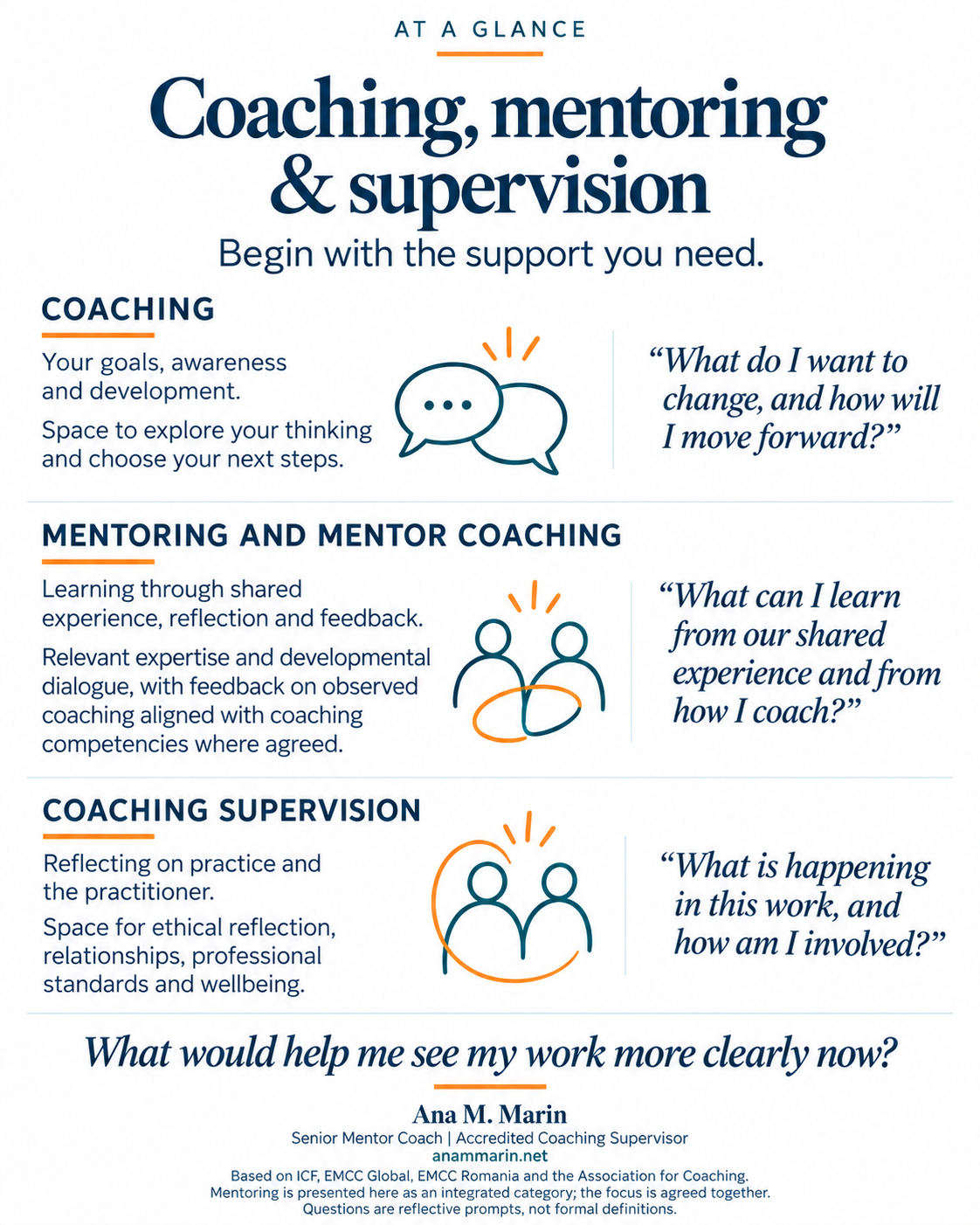
Choosing support as your practice develops
I would encourage newer and experienced coaches to choose support according to their learning needs. ICF presents mentor coaching and supervision as complementary contributions to development. A coach can benefit from specific feedback on their coaching and from broader reflection on their client work. Experience does not make either conversation redundant, and also creates awareness into the coach from the perspective of practice and how they want to design it.
For me, a clear agreement is where this begins. The Global Code of Ethics asks practitioners to ensure that clients and sponsors understand the nature and terms of the work, including confidentiality. It also calls for transparency about methods and appropriate professional competence.
I take this to mean that we need to name the role we are working in and agree what the conversation is for. If I am offering feedback, sharing experience or inviting reflection on a professional dilemma, the coach should understand the purpose and have space to shape how we work together.
Picture source: ChatGPT
Client confidentiality needs equal care. The Code asks practitioners to inform clients that they receive supervision and may refer to them anonymously, while explaining that the supervision relationship is itself confidential. Reflecting on practice brings responsibilities towards the people whose work we discuss.
Whether you are preparing for your first credential or reflecting on a long-established practice, I invite you to pause with a question: what would help me see my work more clearly now? That is a useful place to begin a conversation about the support you need.